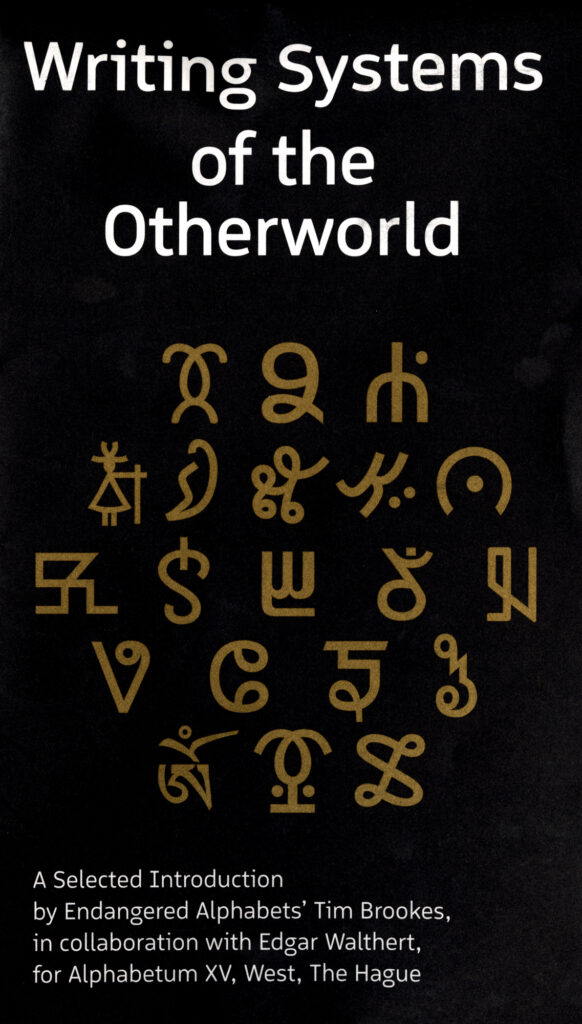
Writing Systems of the Underworld
For the Czech-born Brazilian philosopher and writer Vilém Flusser (1920-1991), history begins with the invention of writing. Before that, there were only stories, passed on orally from one generation to the next. From this perspective, a history of writing is paradoxi-cal: the very tool needed to record it did not yet exist. This paradox makes the origins of writing systems an especially intriguing field of inquiry.
Many attempts have been made to define what a ‘writing system’ is, each producing a different emphasis. It is often more practical, however, to describe what a writing system does. At its core, it consists of a defined set of signs combined with a clear set of rules for how those signs can be arranged. The signs themselves form the system’s vocabulary, while the rules provide its grammar. Together, they enable a writer to compose a graphical sequence of shapes in a specific order, encoding information so that it can later be decoded by a reader. In this way, writing systems are tools that allow us to express, preserve, and transmit thoughts across time-or at least, that is what we believe is happening.
Yet every writing system is also itself a product of human im-agination. It does not grow on trees, nor – at least according to conventional Western belief – was it handed down by extraterrestrial beings. But how self-evident is this assumption, if examined logically? Writing about writing systems often leads us into the kind of self-referential ‘strange loop’ that arises when language tries to describe language. An artist friend once told me: ‘When you are out of words, you are as close as you can get to what language is about.’
Similarly, French writer Hélène Cixous (born 1937), who introduced the concept of écriture féminine, emphasized that writing is never neutral: it inscribes the body, the unconscious, and desire itself. And Indian scholar Gayatri Chakravorty Spivak (born 1942) reminds us that language always exceeds our attempts to control it-translation, for her, is the practice of engaging with the impos-sible, an encounter with what resists mastery.
Instead of tracing a linear history of writing systems, we might therefore turn to the systems themselves, and to the stories attached to them. These stories – whether rooted in myth, dream, or invention – may, after all, reveal something essential about our own mythical existence.