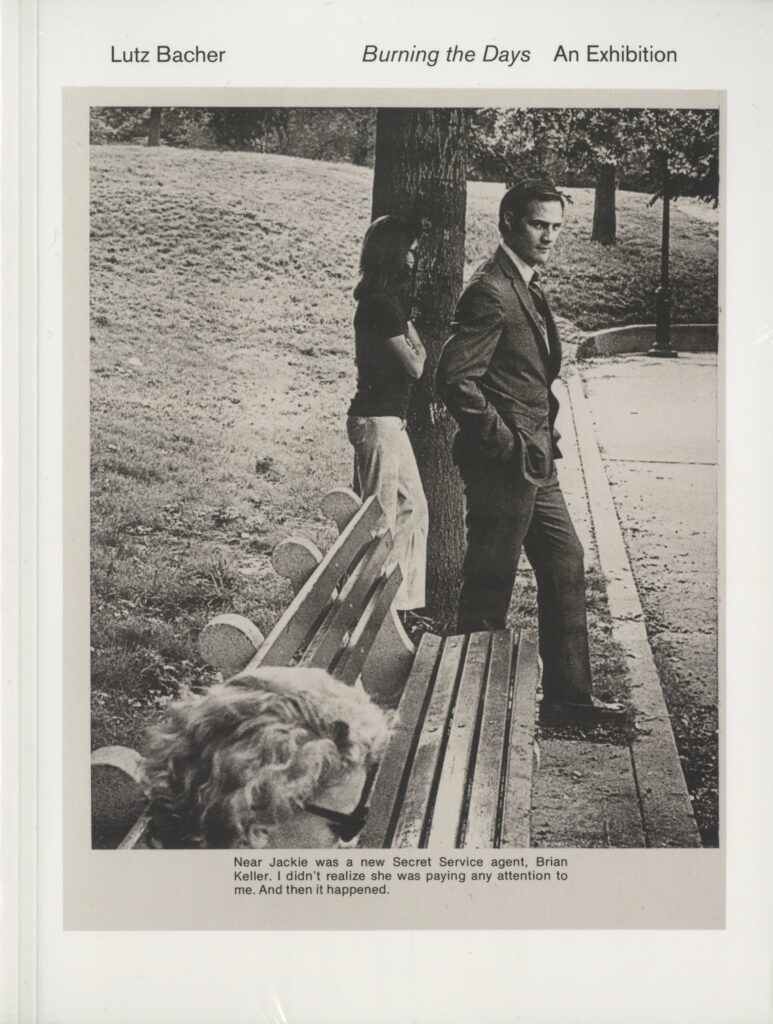
Lutz Bacher: Burning the Days
Published by Astrup Fearnley Museet, WIELS, and Roma Publications, the catalogue brings together three newly commissioned essays approaching Bacher’s art from distinct yet intersecting perspectives. Kate Nesin takes The Betty Center — Bacher’s archive of nearly 300 black binders, later realised as an artwork — as a point of departure to examine her engagement with archives, containers, and readymade forms. Juliane Rebentisch reads Bacher’s work as a sustained practice of opacity that stages accumulation, self-exposure, humour, and citation to unsettle fixed identities and disrupt the clichés through which meaning is usually secured. Finally, Emily LaBarge reads Bacher through the logic of the pun, showing how her works hinge on double meanings and perceptual slippages that make uncertainty the condition of viewing. Burning the Days: An Exhibition occupies a distinct place within the lineage of Bacher’s artist books. It is the first major publication on Bacher produced entirely after her death and without her direct involvement or design input.
Lutz Bacher (1943–2019) lived in Berkeley, California and New York City. She began making art in the 1970s under this assumed name. Her earliest artworks were made with a camera. She took her own pictures, as well as transformed found photographs, drawing resonance out of them by distorting them, editing and combining them, or uncovering half-hidden details about them.